| Previous | Next
XPathContents:The Tree Structure of an XML Document
XPath is a non-XML language for identifying particular parts of XML documents. XPath lets you write expressions that refer to the first XPath expressions can also represent numbers, strings, or Booleans. This lets XSLT stylesheets carry out simple arithmetic for purposes such as numbering and cross-referencing figures, tables, and equations. String manipulation in XPath lets XSLT perform tasks such as making the title of a chapter uppercase in a headline or extracting the last two digits from a year. The Tree Structure of an XML DocumentAn XML document is a tree made up of nodes. Some nodes contain one or more other nodes. There is exactly one root node, which ultimately contains all other nodes. XPath is a language for picking nodes and sets of nodes out of this tree. From the perspective of XPath, there are seven kinds of nodes:
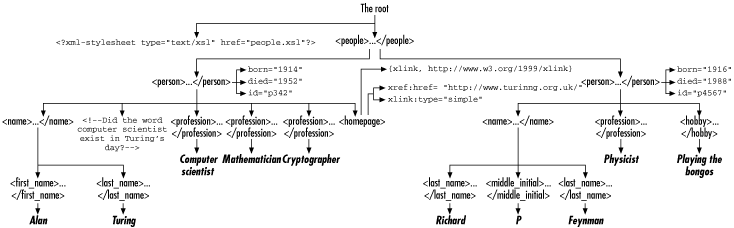
One thing to note are the constructs not included in this list: CDATA sections, entity references, and document type declarations. XPath operates on an XML document after all these items have been merged into the document. For instance, XPath cannot identify the first CDATA section in a document or tell whether a particular attribute value was directly included in the source element start-tag or merely defaulted from the declaration of the element in a DTD. Consider the document in Example 9-1. This exhibits all seven kinds of nodes. Figure 9-1 is a diagram of the tree structure of this document. Figure 9-1. The tree structure of Example 9-1Example 9-1. The example XML document used in this chapter<?xml version="1.0"?> <?xml-stylesheet type="application/xml" href="people.xsl"?> <!DOCTYPE people [ <!ATTLIST homepage xlink:type CDATA #FIXED "simple" xmlns:xlink CDATA #FIXED "http://www.w3.org/1999/xlink"> <!ATTLIST person id ID #IMPLIED> ]> <people> <person born="1912" died="1954" id="p342"> <name> <first_name>Alan</first_name> <last_name>Turing</last_name> </name> <!-- Did the word computer scientist exist in Turing's day? --> <profession>computer scientist</profession> <profession>mathematician</profession> <profession>cryptographer</profession> <homepage xlink:href="http://web.archive.org/web/www.turing.org.uk/"/> </person> <person born="1918" died="1988" id="p4567"> <name> <first_name>Richard</first_name> <middle_initial>P</middle_initial> <last_name>Feynman</last_name> </name> <profession>physicist</profession> <hobby>Playing the bongoes</hobby> </person> </people> The XPath data model has several nonobvious features. First of all, the root node of the tree is not the same as the root element. The root node of the tree contains the entire document including the root element, as well as any comments and processing instructions that occur before the root element start-tag or after the root element end-tag. In Example 9-1, this means the root node contains the However, the XPath data model does not include everything in the document. In particular, the XML declaration, the DOCTYPE declaration, and the various parts of the DTD are not addressable via XPath, though if the DTD provides default values for any attributes, then those attributes are noted by XPath. The Finally, |